 Costa Rica Hot Springs Tours
Natural Hot Springs in Costa Rica: Which Pools Are Genuinely Natural and What Natural Means
Natural hot springs in Costa Rica exist in every hot springs region, but the word natural covers at least five different things. Some soaks happen in river pools on a live hot river, some in pools fed straight from a volcanic spring, some on guided walks to wild pools, and some in constructed pools that only use natural hot water. This guide separates the genuinely natural options from the piped ones, answers whether any are free, explains the safety picture, and shows how to get into each one. For bookable options across all three regions, compare the hot springs tours on CostaRicaHotSpringsTours.com, and it sits alongside Costa Rica Hot Springs Tours.
Quick answer Which Costa Rica hot springs are natural
Yes, Costa Rica has natural hot springs, and the most natural are river pools such as the Río Negro riverbank pools at Hacienda Guachipelín, the Arenal hot river, and Río Perdido's thermal canyon, which is fed by Miravalles volcano. A self-guided day at Río Negro with a waterfall and lunch costs $76 on the Río Negro day pass. Most other so-called hot springs are constructed pools filled with natural volcanic water.
Key takeaways
- Soak in genuine river pools on the Río Negro hot springs day pass with mud and a waterfall for $76.
- Walk to wild thermal pools on a guided Sensoria rainforest hike, access only by booked tour.
- Soak in a free-flowing hot river rather than a pool on the Arenal morning hike and hot river tour.
- Compare every region and price on our Costa Rica hot springs tours homepage.
What Natural Actually Means in Costa Rica
Costa Rica sits on the Pacific Ring of Fire with more than 200 volcanic formations, including Rincón de la Vieja, Miravalles, Arenal, Poás and Turrialba. Heat from these volcanic systems warms underground water that surfaces as hot springs, often mineral-rich with sulfur and magnesium after passing through volcanic rock.
Five Kinds of Natural
The word natural gets stretched across five different products. First, river pools on a live river: the hot water rises through the riverbed and mixes with the stream, so the pools are shaped by the river itself. Second, pools filled from a spring: the water is genuinely volcanic but the basin is built. Third, guided walks to wild pools, where access is only possible with a booked tour. Fourth, mud pots and boiling springs you can look at but never enter. Fifth, constructed resort pools supplied by a thermal well, which marketing still calls natural. Knowing which kind you are buying is the single most useful question to ask before booking any hot springs tour in Costa Rica.
All three of the country's hot springs regions sit on this same volcanic plumbing. Rincón de la Vieja and Miravalles anchor the Guanacaste clusters, Arenal anchors La Fortuna, and the valley between Rincón de la Vieja and Miravalles even hosts one of the world's larger geothermal electricity projects, which tells you how strong the underground heat source is. Our Guanacaste hot springs and Miravalles hot springs pages cover those clusters in detail.
- River pools on a live river: the most natural bathing experience
- Spring-fed pools: natural volcanic water, built basins
- Guided walks to wild pools: access by booked tour only
- Mud pots and boiling springs: look, photograph, never enter
- Constructed resort pools: thermal water, engineered setting
Sources: Río Negro Hot Springs, Hacienda Guachipelín, Hacienda Orosi and Rincón de la Vieja Volcano on Wikipedia.
The Genuinely Natural Hot Springs
These are the venues where the water sits in a river, a canyon or a wild forest pool rather than a built basin. Each links to its region page with more detail.
Río Negro at Hacienda Guachipelín, Rincón de la Vieja
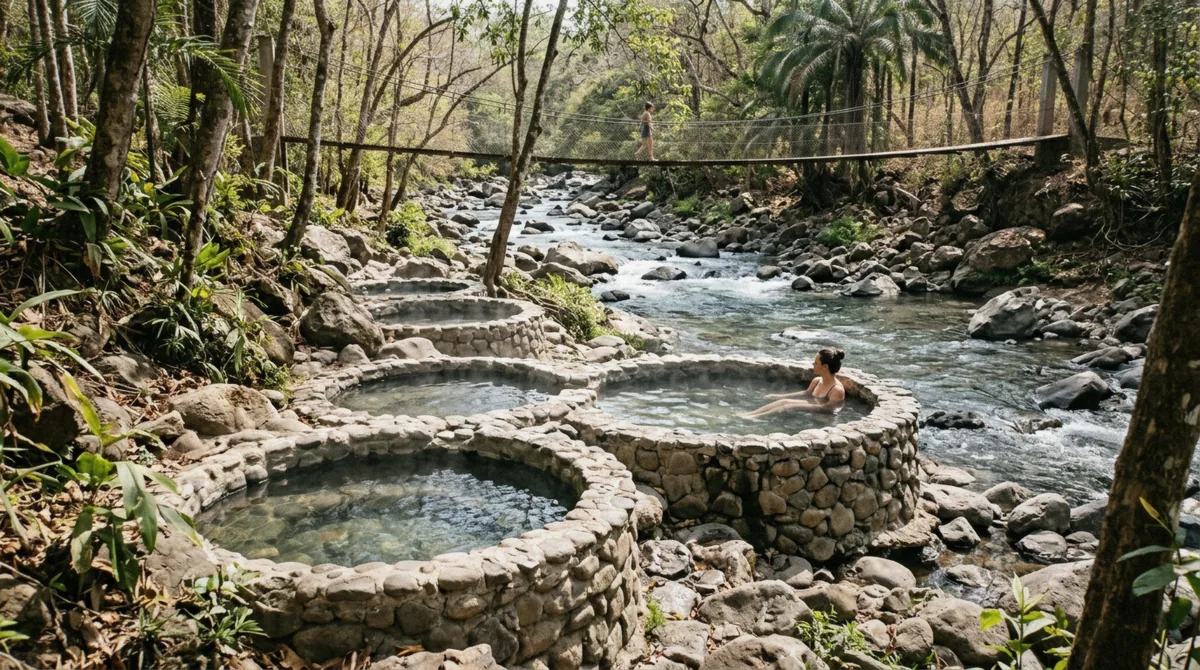
Río Negro is the clearest example of natural river pools near Liberia. Ten pools sit built on the riverbank, meaning the river fills them naturally, and you reach them by a 350-meter forest path over two suspension bridges. Entry runs on 1.5-hour timed entries daily from 9 a.m. to 4 p.m.
On this site the venue is sold as the Río Negro hot springs day pass at $76 (4.7 stars, 37 reviews), a 5-hour self-guided combo that adds the Oropendola Waterfall, a volcanic mud spa and a buffet lunch. Bring your own car, since the sites sit several kilometers apart. More detail on our Río Negro hot springs page.
The Arenal Hot River, La Fortuna
Around La Fortuna, Arenal warms rivers as well as resort pools. On the booked side, the Arenal morning hike and hot springs river tour costs $61.54, lasts 6 hours, and pairs a guided volcano hike and lunch with a soak in the natural river rather than a resort pool. Bring your own towel and bottled water, since neither is included.
Our Costa Rica Hot Springs Tours lists the other La Fortuna options.
Río Perdido's Thermal Canyon, Miravalles
Río Perdido near Bagaces is built around a natural thermal river running through a canyon, one of the few venues in the country where you bathe in moving water rather than a pool. Canyoning and aerial adventure add-ons are available. No current day-pass price could be confirmed.
See our Miravalles hot springs page for the region.
Sensoria's Wild Forest Pools, Rincón de la Vieja
Sensoria is a private rainforest reserve where the thermal pools are reached on foot, on a guided hike past two waterfalls. There is no drive-up entrance: access is exclusively by booked tour, and daily attendance is capped. Three named pools, Jicara, Danta and Pilon, sit along the trail.
The Sensoria hot springs and waterfall tour costs $190 (4.8 stars, 105 reviews), runs up to 6 hours, includes a welcome cocktail and lunch, and has a minimum age of 5. Our Rincón de la Vieja hot springs page covers the whole volcano area.
Spring-Fed Pools: Natural Water, Built Basins
These venues pipe water straight from a volcanic source into constructed pools. The water is genuinely thermal, the setting is engineered.
Blue River Resort
Blue River Resort & Hot Springs near the Rincón de la Vieja road keeps four mineral hot spring pools and one freshwater pool, filled from its own spring source. The water arrives green-tinted from its mineral content. The resort sells the visit as the Blue River full-day adventure at $175 (8 hours), which adds a hike past 4 waterfalls on the Río Penjamo, a botanical garden with about 700 plant varieties, a butterfly park and lunch, with the pools last before the roughly 4:00 p.m. return.
Pickup covers Tamarindo, Pinilla and Conchal hotels only. Details on our Blue River hot springs page.
Hacienda Orosi, Orosi Valley
Hacienda Orosi keeps seven thermal mineral pools ranging 34-39°C, about an hour southeast of San José by paved road, roughly 35-40 km, no 4x4 needed. Its Irazu volcano and mineral hot springs tour costs $198 for 5-7 hours with San José pickup, a Cartago basilica stop and lunch, but note the $19 Irazu Volcano National Park government service fee is billed separately. The pools are constructed, yet the mineral water is naturally heated.
Our Orosi hot springs and hot springs near San José pages have more.
Yökö Termales and Termales Miravalles
Yökö Termales near Bagaces is a long-running local complex with four thermal pools of different temperatures, two jacuzzis and a Turkish steam bath using Miravalles volcano water, plus camping and a restaurant of more than 25 years. Entrance is reported at $10 (₡5,000) for adults and $6 (₡3,000) for children under 10, reported because the official site does not print prices. Termales Miravalles near Guayabo is a rustic retreat piping volcanic spring water at 4.6 liters per second into four pools of varying temperature on a roughly 6,000 sqm property.
See Miravalles hot springs for both.
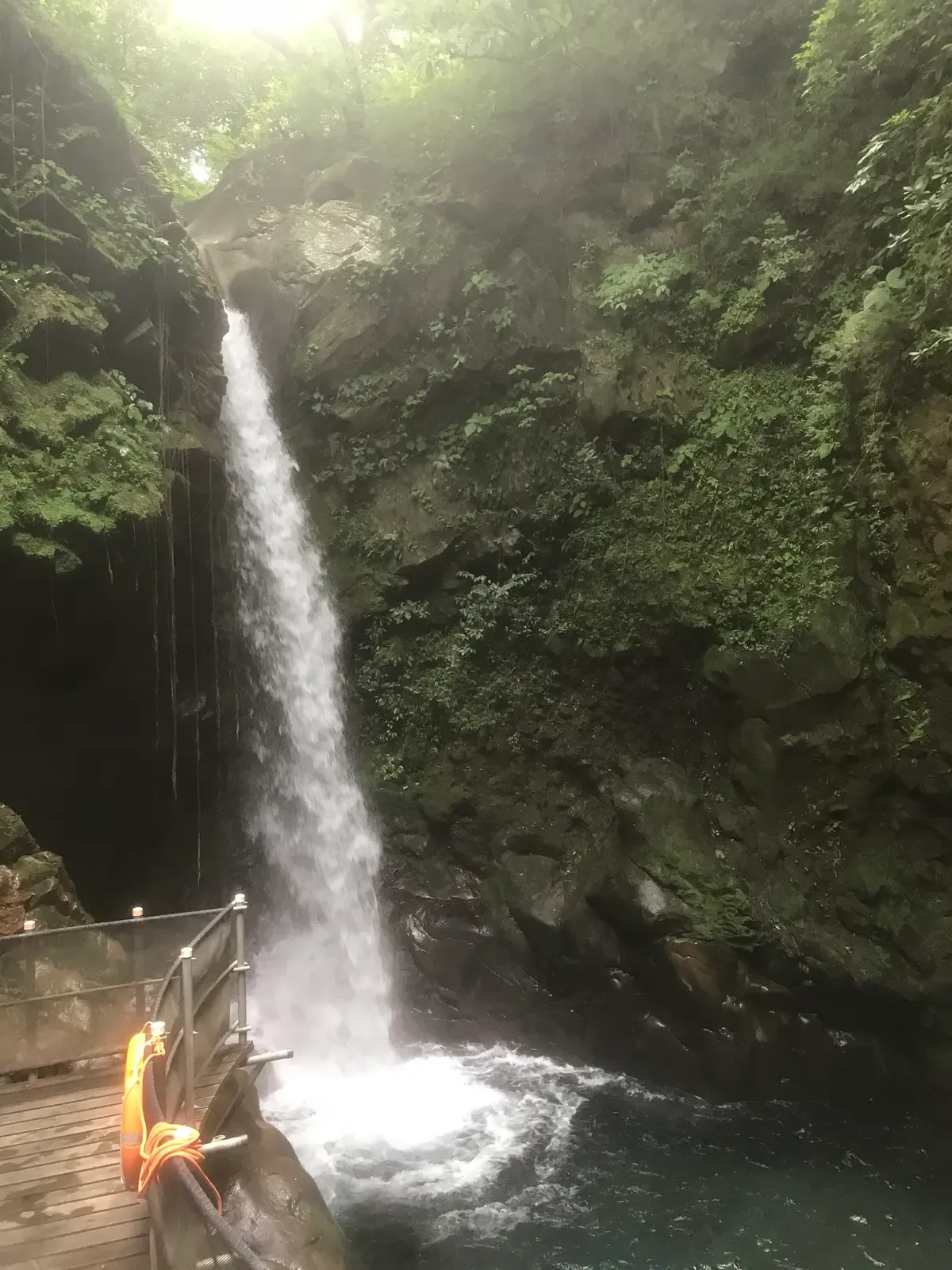
The Oropendola Waterfall near the Río Negro springs. Photo: Alanatoby, CC BY-SA 4.0, via Wikimedia Commons
Boiling Springs and Mud Pots: Look, Never Enter
Two Guanacaste venues offer genuinely wild geothermal features, but the features themselves are for walking past, not bathing in.
Las Pailas and Las Hornillas
On Rincón de la Vieja, the Las Pailas trail in the national park passes boiling springs and fumaroles, and a stop there is part of the volcano hike, waterfall swim and hot springs combo, a 12-hour day at $125 (4.7 stars, 789 reviews) ending with a hot spring soak at a safe bathing venue. On Miravalles' southern slope, Las Hornillas is a family-run rural lodge where you walk among active bubbling mud pots called pailas, then take a mud bath in the thermal pool area. Access there is reported at $40 for adults and $30 (ages 4-10), reported because the official Rates page could not be confirmed.
Posted trail boundaries at these sites exist for a reason and should never be crossed. Both sit in our Guanacaste hot springs coverage.
Free and Nearly Free Hot Springs
The honest answer on cost: outside the La Fortuna area, no genuinely free natural hot springs were confirmed, and the cheapest Central Valley option costs a token fee rather than nothing.
What Free Actually Exists
Around La Fortuna, the hot river pools along the Río Chollín can be entered without charge, which is why the area dominates every free hot springs search. Outside La Fortuna, genuinely free, unstaffed natural hot springs were not confirmed in Guanacaste or the Central Valley. In the Orosi Valley, a small public thermal pool, the Balneario Termal, is reported next to the Orosi Lodge charging only a token entrance fee, so treat it as low-cost, not zero-cost, and ask locally for the current charge.
Also in Orosi, the Balneario Los Patios public bathing complex is a simpler budget option: reported entry of ₡4,000, a group rate of ₡3,000 for parties of 25 or more, and an ₡18,000 all-day pass reported to include three meals, open 8:00 a.m. to 4:00 p.m. daily with two medium pools at 30°C and children under 90 cm not paying. These figures are reported, not confirmed on an official site. Our Orosi hot springs page covers the valley.
Natural Springs and How You Get Into Them
The table below compares the venues this page covers, what kind of water each one really has, and how a visitor gets in. Figures come from the venue listings and tour listings, with tour prices given where this site sells the venue.
| Spring | What the water is | How to get in |
|---|---|---|
| Río Negro (Guachipelín) | 10 riverbank pools on a live river, with volcanic mud | Self-drive, timed 1.5-hour entries 9 a.m. to 4 p.m., or the $76 day pass tour |
| Arenal hot river | Free-flowing hot river below the volcano | Wade in freely around La Fortuna, or on a $61.54 guided 6-hour tour |
| Río Perdido thermal river | Thermal river in a canyon | Hotel and adventure resort access, day price not published |
| Sensoria pools | Wild mineral pools in rainforest, 3 named pools | Guided booked tour only, $190, minimum age 5 |
| Blue River Resort | Spring-fed mineral pools, 4 hot plus 1 freshwater | $175 full-day tour from Tamarindo, Pinilla or Conchal |
| Hacienda Orosi | 7 constructed pools of thermal mineral water, 34-39°C | Paved-road drive from San José, or $198 tour plus $19 park fee |
| Yökö Termales | Constructed pools on Miravalles volcano water | Drive-up local complex, reported $10 (₡5,000) |
| Las Hornillas | Bubbling mud pots and fumaroles, plus bathing pools | Walk with the family-run lodge, reported $40 |
| Las Pailas (Rincón de la Vieja) | Boiling springs and fumaroles, no bathing | National park trail, on the $125 combo tour |
| Balneario Termal, Orosi | Small public thermal pool | Walk-up, token fee, re-verify locally |
Where the Prices Sit
Across the venues no tour sells on this site, the reported figures run from a reported $10 (₡5,000) at Yökö to a reported $40 at Las Hornillas. Where a tour sells the venue, the tour price is the number to budget: $76 at Río Negro, $125 on the volcano hike combo, $175 at Blue River, $190 at Sensoria and $198 at Hacienda Orosi. Where the record lists conflicting figures for one venue, the newer figure is quoted and the older one dropped.
Is It Safe to Swim in Hot Springs in Costa Rica
Yes, at the commercial venues bathing is safe and closely managed. The risks concentrate in three places: slippery rock, strong sun, and geothermal ground you should not step off the trail onto.
The Three Real Risks
First, wet volcanic rock and mud underfoot. Natural-river and mud-bath venues such as Río Negro and Sensoria, and the mud-pot walking areas at Las Hornillas, involve slippery surfaces, so water shoes or secure sandals are commonly advised. Second, heat and sun.
Guanacaste's springs sit in a hotter, sunnier, more exposed climate than the Arenal side, so sun protection and drinking water between pools matter more there. Third, active geothermal ground. Sites such as Las Hornillas and Termales Miravalles sit near fumaroles and boiling mud pots, and posted trail boundaries mark genuinely dangerous ground.
Stay inside them. Where a listing names age rules, respect them: the Sensoria tour has a minimum age of 5, river tubing on the Guachipelín combo starts at 8, and the Río Negro day pass is not suitable for pregnant women.
Swimwear and Mud Etiquette
Do you take your clothes off in a hot spring? No. Costa Rica's commercial hot springs, both around Arenal and in Guanacaste and Orosi, are swimsuit-required facilities, and nudity is not permitted at any venue covered here. Dressing rooms and lockers are provided for changing.
The volcanic mud bath is part of the product at the Guanacaste venues, a spa-style mask applied before you rinse in the river or a cold pool, not a gimmick, so plan to get thoroughly muddy. Lockers at the Guachipelín tour base take a $5 deposit, refunded when you return the key, and towels are your own responsibility on several tours: the volcano hike combo asks you to bring one, while the Río Negro day pass provides one for the springs but not for the waterfall.
Do and Don't at Costa Rica's Natural Springs
A short list for bathing in river pools, wild forest pools and geothermal areas without problems.
Do
- Do wear water shoes or secure sandals because wet volcanic rock and mud at river venues such as Río Negro and Sensoria are slippery.
- Do bring your own towel and bottled water where the listing excludes them, as on the $61.54 Arenal hot river tour.
- Do plan your own transport for the Río Negro day pass because its sites sit several kilometers apart and no pickup is included.
- Do respect posted boundaries at mud pots and fumaroles because the ground at Las Hornillas and Las Pailas is genuinely dangerous beyond them.
- Do budget for the extras that are billed separately, such as the $19 Irazu park fee on the Hacienda Orosi tour or the $70 per-booking transport fee for gated Papagayo resorts on the Guanacaste combos.
Don't
- Don't enter boiling springs or mud pots anywhere, because those features are for walking past, never bathing.
- Don't count on a free soak outside La Fortuna, because no genuinely free natural springs were confirmed in Guanacaste or the Central Valley.
- Don't expect nudity to be tolerated, because every commercial venue here requires swimwear.
- Don't assume a resort pool is a wild pool, because most so-called natural springs are constructed basins fed by volcanic water.
- Don't skip sun protection in Guanacaste, because the springs there sit in hotter, more exposed conditions than around Arenal.
Natural Hot Springs in Costa Rica: Questions
Does Costa Rica have natural hot springs?
Yes. The most natural bathing happens in river pools such as the 10 riverbank pools at Río Negro and the thermal river canyon at Río Perdido, plus wild forest pools at Sensoria reached on a guided Sensoria hot springs and waterfall tour. Most other venues are constructed pools filled with genuinely volcanic water.
Are there free hot springs in Costa Rica?
Around La Fortuna, yes, the hot river pools can be entered without charge. Outside La Fortuna, no genuinely free natural springs were confirmed, though Orosi has a low-cost public Balneario Termal and the budget Balneario Los Patios, both covered on our Orosi hot springs page.
Is it safe to swim in hot springs in Costa Rica?
Yes at the commercial venues, where bathing is managed and timed. The real risks are slippery wet rock, strong Guanacaste sun, and geothermal ground near mud pots, so follow the safety notes on our Rincón de la Vieja hot springs page and stay inside posted trail boundaries.
Which are the best natural hot springs in Costa Rica?
For genuinely natural bathing, the shortlist is Río Negro's riverbank pools, Río Perdido's thermal river canyon, the Arenal hot river and Sensoria's wild pools. The Río Negro day pass at $76 is the easiest natural-river soak to book, and the full comparison lives on Costa Rica hot springs tours.
Do you wear a swimsuit in Costa Rica hot springs?
Yes, always. Every commercial venue covered here requires swimwear and provides dressing rooms and lockers, and the mud bath at the Guanacaste venues is a spa-style mask applied in your suit before a cold rinse, as described on our Guanacaste hot springs page.
Can you visit Río Perdido's thermal river as a day guest?
The resort advertises day access, but no current day-pass price could be confirmed. Our Miravalles hot springs page lists the venues with confirmed pricing in that region.
Is a hot springs tour worth it if the river is free?
A booked tour adds what the free river cannot: transport, a guided hike, lunch and context. The Arenal morning hike and hot river tour costs $61.54 for 6 hours including lunch and hotel pickup, and the adventure combos on our Costa Rica Hot Springs Tours page add ziplines or waterfalls to the soak.